
Graphs: directed graphs cycles
In software engineering there are lots of useful data structures. One of the useful structures is the graph. In this article I plan to take a directed graph and an algorithm for finding cycles.
What is a cycle?
A cycle is a path in which all vertices are unique except the first and last node.
Example:
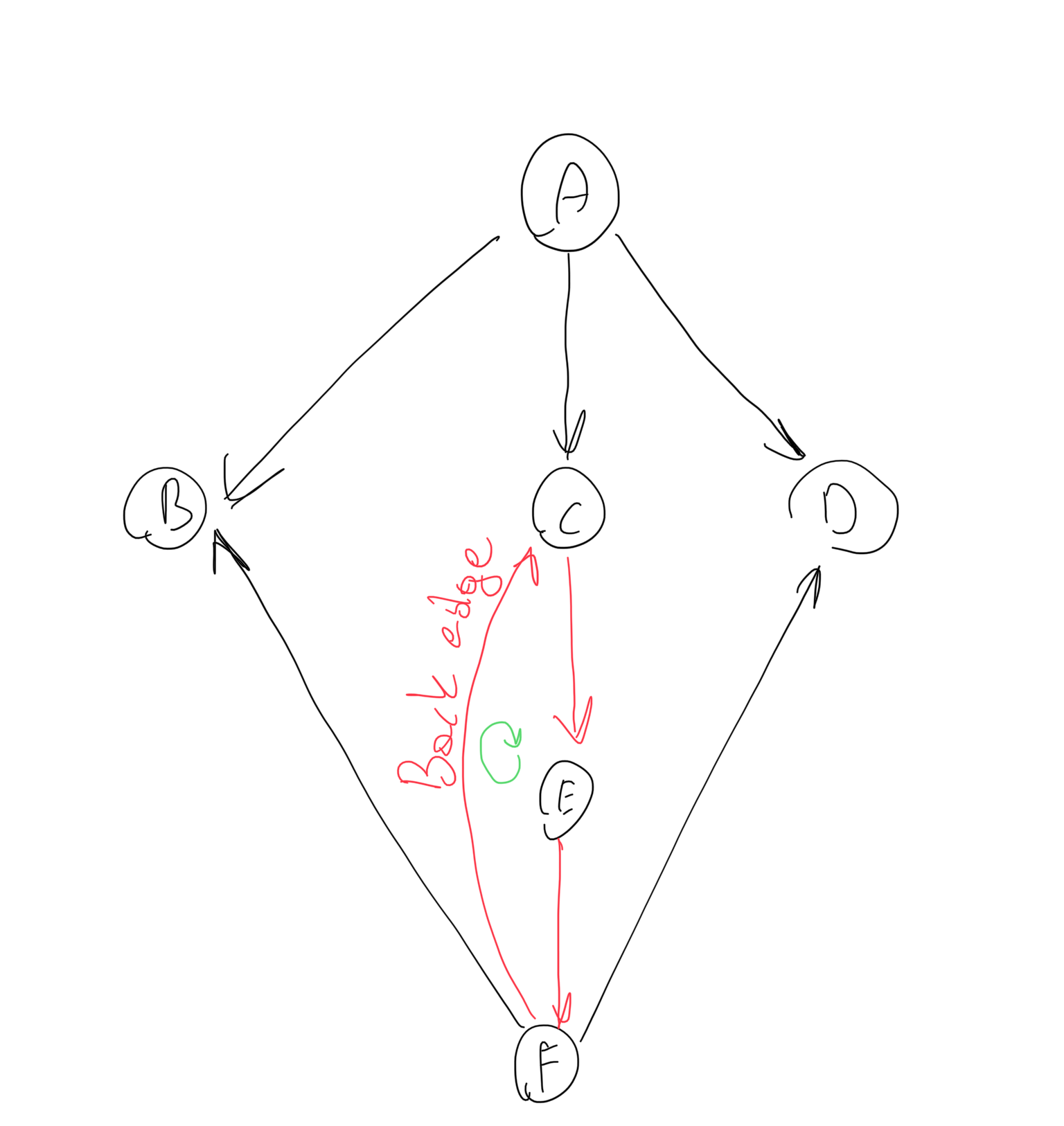
The cycle, path, is C -> E -> F -> C
A directed graph that does not have a cycle is a directed acyclic graph, or DAG for short.
Example:
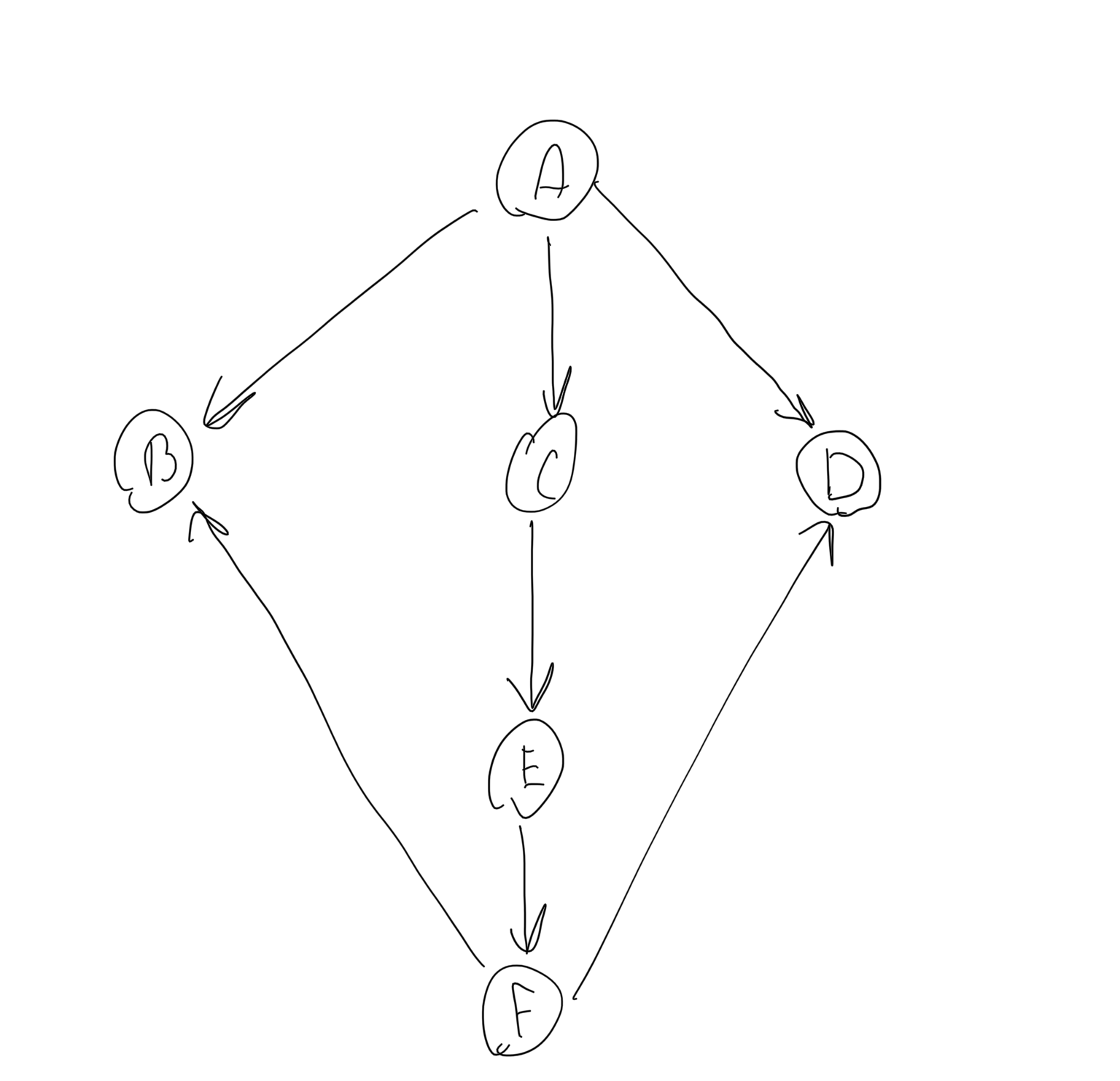
Going forward, let’s write some code that will check if a given graph has a cycle or is a DAG.
At the beginning, let’s discuss a little bit how to perform this task and make an algorithm sketch.
- Start in any node
- Mark node as gray, visiting
- Visit node descendants
- When node does not have any descendants mark as black, visited
- When all descendants are black, visited, also mark node as visited
- If any descendant during traversing the graph meets a gray (visiting) node, then a cycle exists
- Repeat 1 - 6 starting for each node in graph
Simple visualization:

Then let’s implement it as simple recursion, DFS
import scala.collection.mutable
import scala.collection.mutable.{Stack, Set => MSet}

def hasCycleRec(graph: Map[String, List[String]]): Boolean = {
    val visiting = MSet.empty[String]
    val visited  = MSet.empty[String]

    def checkCycle(node: String): Boolean = {
      if (visited.contains(node)) {
        false
      } else if (visiting.contains(node)) {
        true
      } else {
        visiting.add(node)
        for (n <- graph(node)) {
          if (checkCycle(n)) {
            return true
          }
        }

        visiting.remove(node)
        visited.add(node)
        false
      }
    }

    for (n <- graph.keys) {
      if (checkCycle(n)) return true
    }

    false
  }
However, recursion has stack size limitations, so let’s implement the algorithm in an iterative manner
import scala.collection.mutable
import scala.collection.mutable.{Stack, Set => MSet}

def hasCycleStackSafe(graph: Map[String, List[String]]): Boolean = {
    val visiting = MSet.empty[String]
    val visited  = MSet.empty[String]
    val stack    = mutable.Stack.empty[String]

    for (n <- graph.keys) {
      stack.push(n)
      while (stack.nonEmpty) {
        val cn = stack.pop()
        if (!visited(cn)) {
          val descendants = graph(cn)
          if (descendants.isEmpty || descendants.forall(visited)) {
            visiting.remove(cn)
            visited.add(cn)
          } else if (visiting(cn)) {
            return true
          } else {
            visiting.add(cn)
            for (d <- descendants) {
              stack.push(d)
            }
          }
        }
      }
      visited.addAll(visiting)
      visiting.clear()
    }

    false
  }
But I am using Scala and I am not fully satisfied with this solution, so let’s make it using tail recursion:
import scala.annotation.tailrec
import scala.collection.mutable
import scala.collection.mutable.{Stack, Set => MSet}

def hasCycleTailRec(graph: Map[String, List[String]]): Boolean = {
    val visiting = MSet.empty[String]
    val visited  = MSet.empty[String]

    @tailrec
    def hasCycle(stack: List[String]): Boolean = {
      stack match {
        case Nil =>
          visited.addAll(visiting)
          visiting.clear()
          false
        case head :: tail if visited(head) => hasCycle(tail)
        case head :: tail =>
          graph(head).filterNot(visited) match {
            case Nil =>
              visited.add(head)
              visiting.remove(head)
              hasCycle(tail)
            case _ if visiting(head) => true
            case descendants         =>
              visiting.add(head)
              hasCycle(descendants ++ tail)
          }
      }
    }

    @tailrec
    def loop(xs: List[String]): Boolean = {
      xs match {
        case Nil                                   => false
        case head :: tail if !hasCycle(List(head)) => loop(tail)
        case _                                     => true
      }
    }

    loop(graph.keys.toList)
  }
Now is better, however it could be done more idiomatic and functional:
import scala.annotation.tailrec
import scala.collection.mutable
import scala.collection.mutable.{Stack, Set => MSet}


def hasCycleTailRecMoreFunctional(graph: Map[String, List[String]]): Boolean = {
    @tailrec
    def hasCycle(stack: List[String], visiting: Set[String], visited: Set[String]): (Boolean, Set[String]) = {
      stack match {
        case Nil => (false, visited ++ visiting)
        case head :: tail if visited(head) => hasCycle(tail, visiting, visited)
        case head :: tail =>
          graph(head).filterNot(visited) match {
            case Nil => hasCycle(tail, visiting - head, visited + head)
            case _ if visiting(head) => (true, visited)
            case descendants         => hasCycle(descendants ++ tail, visiting + head, visited)
          }
      }
    }


    def loop(xs: List[String], visited: Set[String]): Boolean = {
      xs match {
        case Nil => false
        case head :: tail => hasCycle(List(head), Set.empty, visited) match {
          case (isCycle, visited) if !isCycle => loop(tail, visited)
          case _ => true
        }
      }
    }


    loop(graph.keys.toList, Set.empty)
  }
I hope it will be useful not only in the recruitment process but also in the daily job ;)